How to Replicate Over/Under

My social media feed has been consumed by indie TTRPG insiders processing the emotional impact of Sam Sorenson's Over/Under on their lives.
To those unfamiliar, Sam attempted to create a real-time play-by-post wargame set on Mothership’s best module, but he accidentally created an enormous text-only LARP instead. Ramanan’s summary of the game is the most digestible, as an informed and well-spoken ‘outsider’ to the madness himself. Research freaks should instead dive into Jack Shirai’s intricate daily summary of events.
To me and a handful of others (shoutout to Mondo Terminal, Paige Laux, and "Da Weed Whackerz") this deeply moving roleplay experience was quite familiar. Despite the gaming community’s outpouring of joyful surprise, this was not the first time such a social metagame - which I’m calling “Live Text Roleplay (LTRP)”1 - has grown from another game’s soil.
I wrote this article to ensure it won’t be the last. I will teach you how to grow your own.
My Bona Fides
LTRP was my primary hobby for the entirety of my late 20s. I’ve watched identical RP cultures emerge out of half a dozen West Marches discord servers running all sorts of TTRPG systems (5e, Lancer, Fabula, Masks). I’ve written 110,448 posts across four such servers - an average of 38 posts per day, every day, since 2017.2
At the end of O/U, folks joked that this game would lead to several marriages. I can say from experience that's correct. I know of four separate households composed of folks who met playing these games, and half a dozen romantic relationships. I have helped these people move cross-country. I send them christmas presents. I have helped paint their walls. LTRP's ability to foster deep human connections is completely unmatched.
What is Live Text Roleplay?
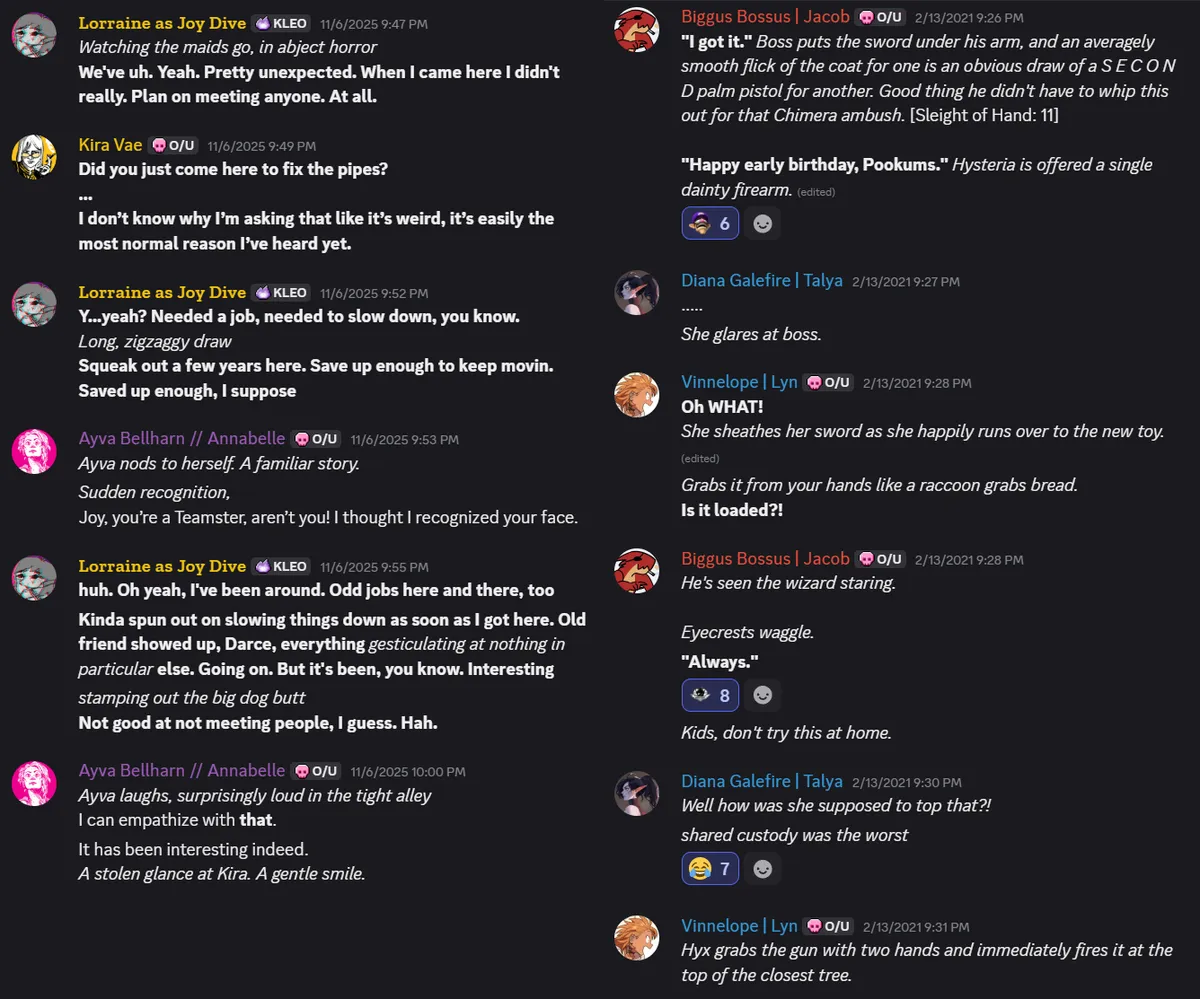
Left: A casual O/U scene in the Smoking Room of The Ember bar.
Right: A four year old scene in which my friends made the mistake of giving Hyx a gun.
Live Text Roleplay is an online synchronous real-time text-first roleplaying event with enough participants to simulate the complexity of a real social environment. Traditionally held on Discord, with text channels corresponding to physical locations in the fictional world (ex., #The_Bar, #The_Hospital, #The_Docks).
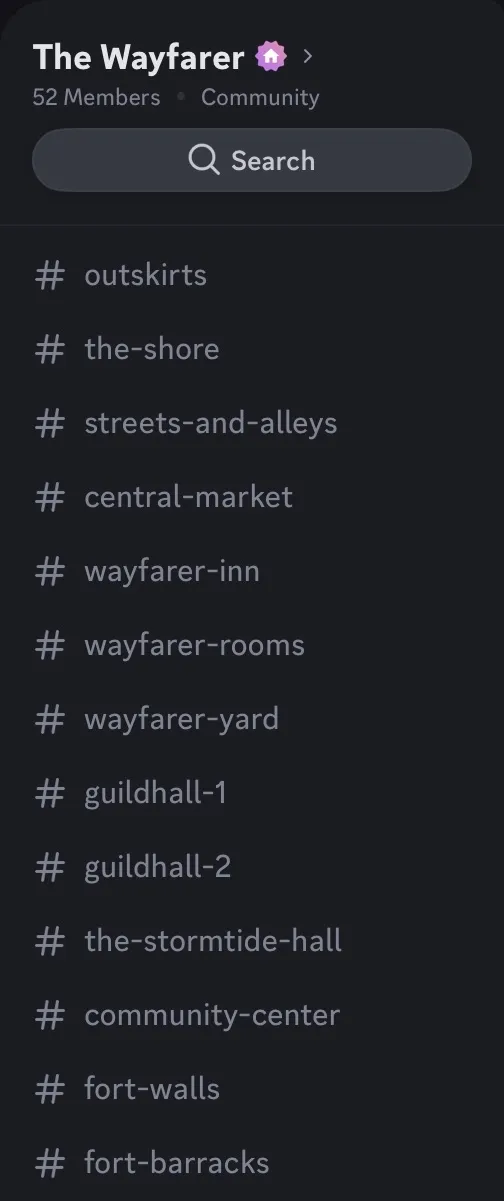
The sheer volume of participants allows each character to have their own inner life - lives they keep living when you aren't looking. It feels real because it is real, socially speaking. You aren't simulating a relationship with the people you meet in these games, even when the people themselves are simulated. You are literally building relationships, using the same small talk and vulnerability that fosters connections in your real life. The bleed must be experienced to be believed.
My prior LTRP servers fluctuated between 25 and 80 active participants. O/U hovered around 500. While its incredible size added to its appeal, you don’t need a server that big to evoke a similar mystique. All that matters is that your server has enough active RPers to ensure you can’t keep up with every story. Not knowing some crucial information and not knowing a lot of crucial information is subjectively similar. Most GMs go to great lengths to evoke the feeling that their world is larger and more alive than what their players can see. In LTRP, that is literally true.
While LTRP is technically an offshoot of Play-by-Post, that comparison obscures more than it illuminates. The actions you take in LTRP are constrained by social rules and the fiction, unmediated by formal rules and mechanics. There is no rule preventing your character from existing in multiple places simultaneously or from suddenly acquiring super strength and laser vision. O/U has proven to me that such rules are unnecessary - adults understand the appeal of committing to the bit.
Can you play LTRP without an underlying game system?
Yes - it's just playing pretend. However, I would strongly advise always layering it atop some sort of game system, so the latter can act as a narrative catalyst. Most of your players are not improv trained. It takes a while to get a sense for how you can help make RP scenes entertaining by setting up conflicts, bits, and intrigue. Most players just walk into a situation with few expectations and look forward to the unpredictable ways their character bounces off of those around them. After spending enough time with the same characters, the outcomes become rote.3 Characters just "do their bits" at one another to predictable results.
In LTRP, some outside force needs to exist that repeatedly and massively shakes up the status quo. In O/U that was the wargame - assassinations, espionage, ARG-triggered mass hysteria. In the prior games I played, these shakeups were triggered by traditional TTRPG sessions - character death & advancement, traveling to new exotic locales, an angry dragon suddenly attacking #The_Town_Gates. Part of what gave the Choke Incursion such terrifying verisimilitude was the way it felt completely outside of anyone's control. It was a thing that was happening to us. Dice can simulate the existence of a wider world full of unpredictable events, but they are merely a substitute. The goal, which LTRP uniquely places within reach, is to actually create a system unstable and complicated enough to cause dramatic consequences no single person intended.

"The Dreamcatcher", one of O/U's diegetic newspapers.
What games pair well with Live Text Roleplay?
As a vet of the genre, Over/Under taught me that LTRP pairs better with PvP games than Co-Op games.
O/U had considerably less OoC drama compared to all of my prior LTRP experiences. Some of that credit goes to the mods, some to “interested in Mothership” being such an amazing filter for cool people, but some of it also comes down to players having no expectation that the other players in the game were obligated to help them in any way. League of Legends gained its reputation as the most toxic game on earth because of its high time commitment and reliance on a team of competent teammates to succeed. Both of those are equally true of a high-lethality trad TTRPG session.
The vast peace conspiracy I engaged in during O/U felt so much more real when I knew that naive idealism alone was holding it all together. The care we expressed for one another was real because it was personally costly. ‘Against Incentive’ validated yet again.
PvP has its own costs too. It’s much harder to ‘respawn’ players as new characters when their OoC knowledge comes back with them. However, I found O/U’s solutions to this problem satisfactory - make death permanent and the game duration short.4 The bugbears of growing LTRP atop a trad game were much harder to manage - inequality in player capabilities, dissatisfaction with character “builds” tempting players to abandon existing relationships to start fresh, and OoC pressures to make opposed PCs ‘get along’ so the planned sessions could happen all plagued us for years.
Beyond “PvP” and “Cataphract-likes”, I’m not sure what sorts of games are the best soil for a LTRP to grow. I invite you all to organize into the largest group you can and start experimenting!
—————Advice for GMs—————
Decide how much time you’re willing to spend
Sam was spending three to twelve hours a day GMing O/U. That’s obviously insane and unsustainable. I suspect Sam’s grind had a lot to do with the ‘catalyst game’ being almost as real-time as the RP, and his personal involvement being necessary for the resolution of so many types of player actions.
So I beg you - make sure neither of those are true of your game! You want to give your players as few reasons as possible to add to the inevitable pile of PMs.
You need 25 players at minimum
Any less than that, and you run into problems. The most dedicated players will be able to read every chat, and the game loses its magic. Spaces will become more predictable as the same characters monopolize scenes.5 Instead of walking in on living spaces where characters are already talking, players will be forced to “fish” for scenes by posting opening lines and waiting minutes or hours for another player to take the bait.
You also want as many of your players to be ‘creative types’ as possible, though that’s rarely under your control. Even the most amateur art creates the building blocks of culture - there are MS Paint drawings from the server I played on in 2017 that I reference to this day. Songs, talk radio, newspapers, DJ sets... I doubt I need to sell you on the value of cultural ephemera.
A snippet from "d101.6: The Real Dream" a player-created radio show in Over/Under.
Only use threads in 40+ player games
At lower player counts, letting players hide threads can give the erroneous impression that the RP culture is dead. This starts a vicious cycle of reduced RP engagement. O/U had an infinite number of players, so their ability to hide themselves didn’t matter.
A lot of folks also treat RP as a stage performance and object to how threads hide them from their audience.6 Private threads are a necessary evil in espionage games, but note that allowing players to create locked doors will inevitably make your game so… so much hornier.7
Once you have the player count to afford threads, they’re useful as a way to crowdsource compelling RP environments. The popular locations literally rise to the top. Speaking of…
Create fewer channels than you think you should
You want to pressure characters to interact with each other by forcing them into limited space. If there’s too little space - too many participants in the same channels - scenes can become hard to follow, though. Luckily, it’s easier to add channels than remove them (the latter feels strange in practice). When you do add channels, make it a rare event. Try not to add more than one or two at a time.
Lastly, remember that you cannot force a channel to be popular. Cultural inertia is a powerful force.
Add an out of character “#RP-Discussion” thread.
Players want an outlet for live commentary on ongoing scenes. It’s fun to be the peanut gallery. It’s also crucial for consent check-ins before, during, and after scenes.
Additionally, it’s useful for RPers to have a space outside of a scene where they can ask for OoC clarification on their partner’s posts. “What does your character look like?”, “Are you pointing the gun at me or Janice?”, etc.
Write up a Player’s Guide
Include information on your game’s setting, constraints on PC backstories and in-game actions8, what themes are on or off the table, the local RP norms, and the server’s rules. If you’re playing a trad game, include all the usual stuff (character creation, house rules) as well.
By ‘RP norms’, I’m referring to the communication customs that inevitably develop meaning, like text formatting and emoji jargon. For example, the formatting of my posts represent the following:
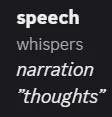
Present these as guidelines, not rules. Players do interesting things with freedom. As for the emoji jargon, in my servers:
📂 = “I am around and want to RP.” When this emoji vanishes from the post, the poster is no longer looking for a scene partner.
👩👩👧👦 = “I want lots of people to stop by this scene.” We referred to these as “group scenes” in contrast to the much more common 1 on 1 scenes. At higher player counts and lower channel counts, group scenes are presumed by default.
🎬 = “I would like to finish the scene with this post.”
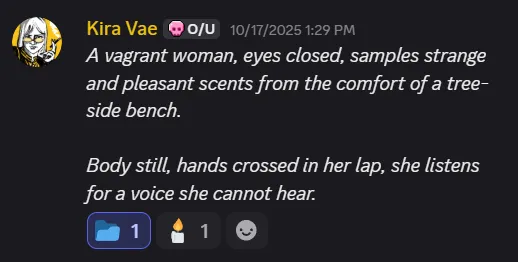
An example "Open"; a post implicitly asking another player to RP with you.
—————Advice for Players—————
Set healthy boundaries
LTRP servers are a digital living room that is always - always - filled with a handful of your close friends. Something you deeply care about could be happening at any time. It's the platonic ideal of a social engagement feed. Communicate your hard cutoff times to your RP partners as early as possible, and stick to them! Knowing when your partner needs to end the scene lets you assist in the scene’s pacing, and gives the writing a more natural flow.
If there are particular topics you're worried might come up, communicate with your scene partners early and often. Check in after emotionally intense scenes.
Read improv advice
Yes that’s right I buried the lead it’s all improv you’re that kinda freak now it’s too late you already cried when Mr. Moneybags danced at the ball search your feelings you know it to be true.
Alternatively watch Dropout.tv
Move elsewhere when a channel is full
“Full” does not mean “when there’s a lot of people there”. The fullness of a channel is determined by the amount of attention it demands of all participants. A channel’s attentional demand is determined by the number of “cameras” an audience needs to keep in mind, and how much each participant’s messages change the status quo.
It’s not a problem for 12+ people to participate in the same scene, assuming they’re keeping up with the pace of conversation and reacting to the same events. When reading a channel becomes too confusing (multiple simultaneous reply chains, fast typers changing the fiction faster than you can react) start a scene in a different place, or open a thread in the same channel.
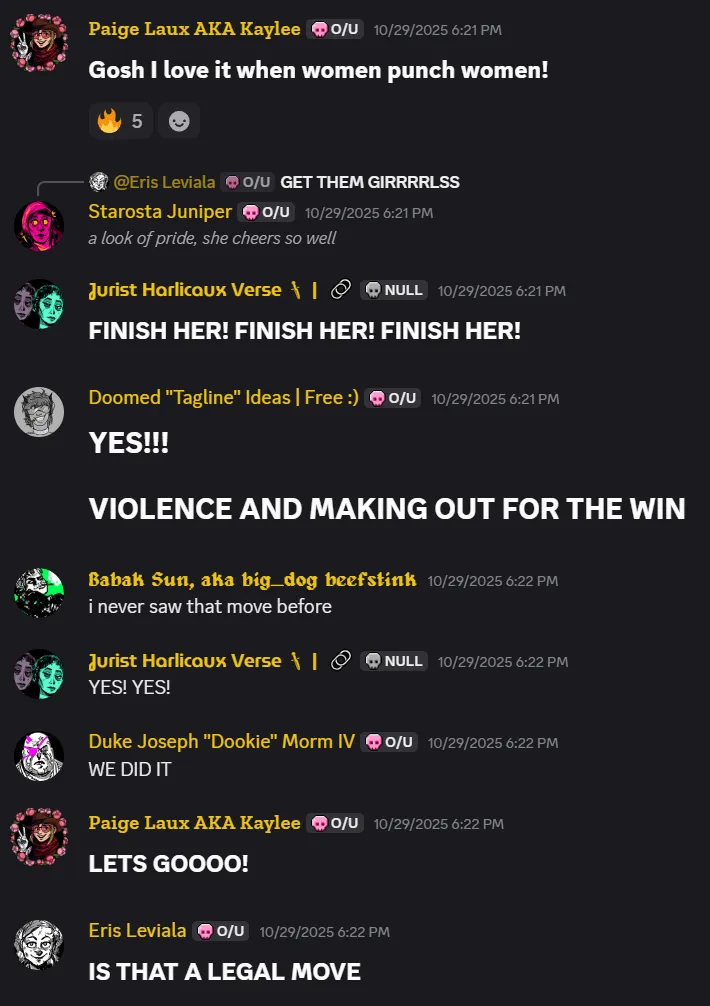
Crowd scenes are a great example of this principle in action. Short, quippy posts that don’t change the status quo. Everyone present is reacting to the same events.
Think physically
It’s easy to fall into the habit of “Just Talking” - posting words alone, back and forth. Think about where your character is and what they’re doing. Spend a line or two narrating that in every post. Add kinetic energy to the imagined space.
How does your character sit? What are their nervous tics? Are they multi-tasking? What are their hands doing? Where are they looking? What is their expression?
These sorts of details are first on the chopping block in busy channels, but they’re crucial to adding life to 1-on-1 conversations.
Read books
I suspect I’m preaching to the choir here, but still. It’s not a coincidence that the most beloved RP threads of O/U were mostly penned by Lin Codega, award-winning journalist and fantasy author.
Coordinate relationships during character creation
If every character begins as a drifter, it takes time for relationships to build enough to result in drama. Skip the slow bits by making your PC invested in other PCs from minute one.
Are you their bodyguard? Secretary? Relative? Enemy? Boss? Have feelings about other people. The NPCs in your backstory will never come up in play. Relationships with other players are visible and dynamic.

Embrace change
The story of a LTRP is about what’s happening now, on screen. One of the most memorable characters I’ve ever seen in an LTRP was “Average Joe”, a 13s-down-the-line Human Fighter with healthy parental relationships. Over the course of a year, we watched this comically unimportant boy be molded into an edgy isekai protagonist by the cruel whims of fate. It ruled. It was sick as hell.
As preached by OSR advice of yore, climbing up from mediocrity produces more compelling arcs than starting cool and remaining cool. Make sure the game you’re playing is the most interesting moment of your character’s life.
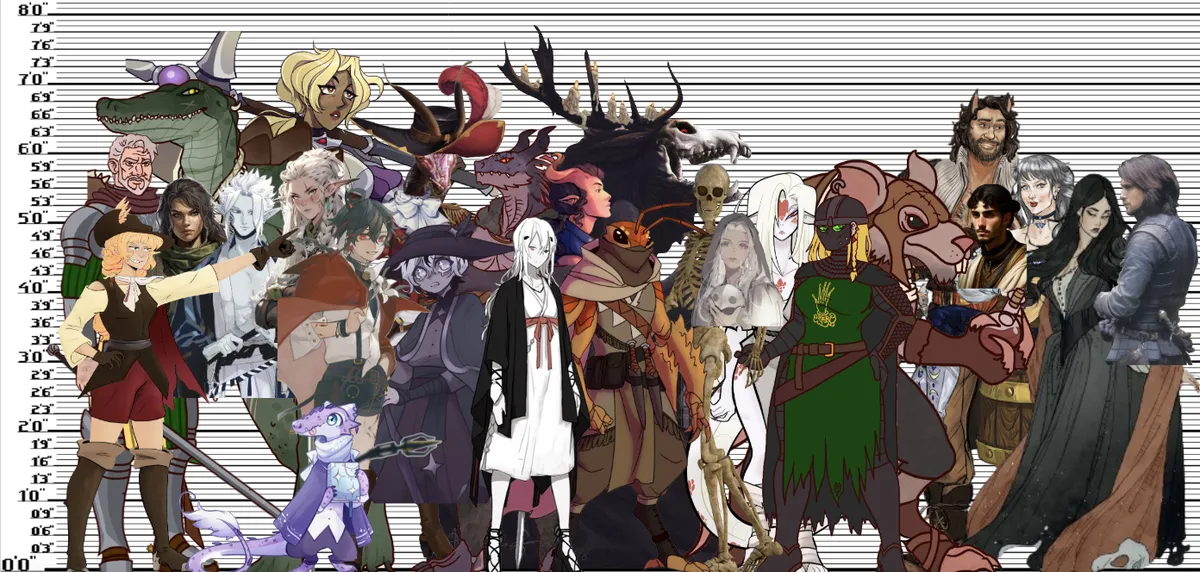
A 'Height Chart', a cherished LTRP tradition.
Go Forth and Be Merry
It’s been so wonderful to watch hundreds of people experience the magic of Live Text Roleplay for the first time. I have seen so many bluesky takes calling Over/Under magic in a bottle, impossible to replicate, as they come down from the high.
All of those people are wrong. We can keep playing these games whenever we want. Some of us never stopped. If you want to, you can keep going. The wonder, terror, and joy are still out there, within reach.
Just try not to slack off too much at work, okay?
————————————————————————————
In contrast to “Live Action Role Playing.” Not the same thing as this Roll to Doubt article, which is about using chat rooms to conduct traditional small party TTRPG games.↩
I recognize the picture this paints of me, and am happy to assure you all that I do, in fact, do other things. I am in shape, love baking, and dote on my bicycle as if it were a small child.↩
This is another reason O/U's one month time limit played into its success.↩
This comes with the notable upside of allowing your players to, eventually, return to a normal sleep schedule.↩
Imagine if the yuri pit were the only people playing O/U. That’s what low player count LTRPs feel like.↩
This was a big cultural shift for me in O/U. I wanted every scene to be as public as possible, to the detriment of opsec. I was also conditioned to treat emoji reactions as twitter likes - I crave them as a form of validation.↩
“Why do people act so horny in text RP?” is beyond the scope of this guide. Dissertation-tier question, which I suspect would uncover depressing truths.↩
GMs need to communicate up front that extreme character consequences require consent. Nothing is off the table with a RP partner you trust, but trust needs to be earned.↩