How Deadly is the OSR, Actually?
Like many reasonable, smart, and beautiful people I was annoyed by this Youtube video Daði published a couple weeks ago.
The argument the video presents, in short:
- OSR campaigns are short and comparatively infrequent. “One night a month or six times a year”
- Therefore, OSR games have to fit more drama into a shorter number of games.
- OSR games use high lethality to create that drama.
- Killing PCs removes the primary way 5e players get invested in TTRPGs.
- CROWS is introducing 5e players used to long campaigns into the OSR by adding base building mechanics that reward long term investment.
Ben already bridged the cultural gap well in his reply video. It’s worth a watch, but I wish he’d taken a beat to interrogate Daði’s unstated assumption that the lethality of a campaign is primarily determined by the DM. It’s clear that Daði is used to play environments where the majority of conflicts encountered were premeditated by the ringleader behind the screen.
Daði defends claim #4 by emphasizing that most of his players define fun as fulfilling a heroic destiny, so adding lethal stakes makes it uncertain whether or not those players will have fun. There’s nothing wrong with wanting to play a game about growth and heroism, but rigging challenges in your players’ favor through encounter balance is a bad way to accomplish that goal. It’s far easier logistically and more gratifying to present genuinely difficult challenges while giving parties guaranteed shots at redemption through surrender mechanics à la Fabula Ultima and Daggerheart.1 This ensures that the outcomes in your game are a consequence of player choice without reducing the campaign to a test of player skill.
However, I’m more interested in claims #1 and #3. Are OSR games universally short and deadly? I suspect not, and asked 200 people the following four questions to prove it.
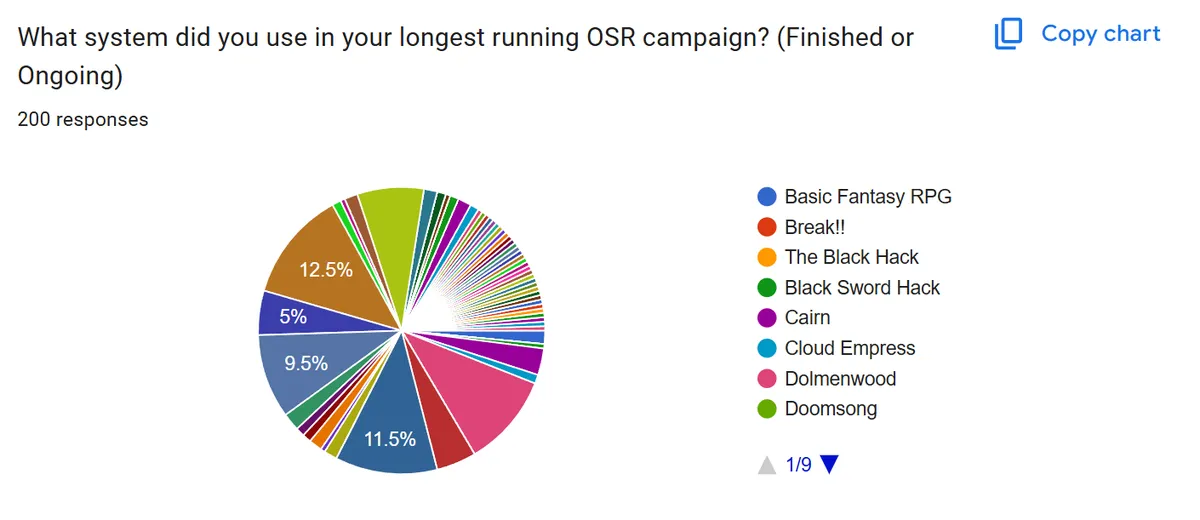
- What system did you use in your longest running OSR campaign? (Finished or Ongoing)
- How many sessions long is/was that campaign?
- How long were those sessions on average, in hours?
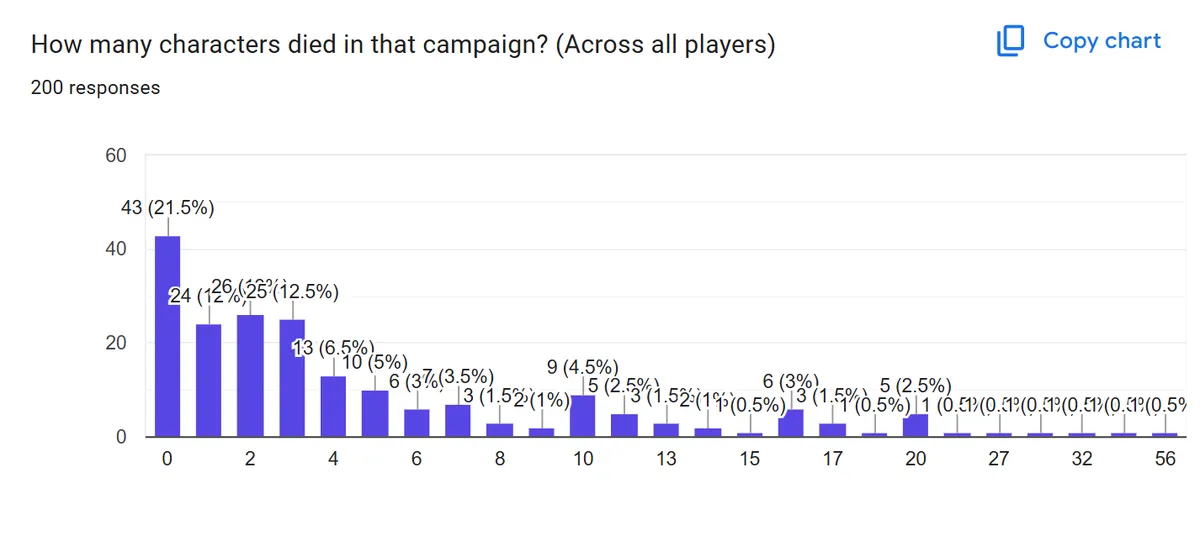
- How many characters died in that campaign, across all players?
The Data
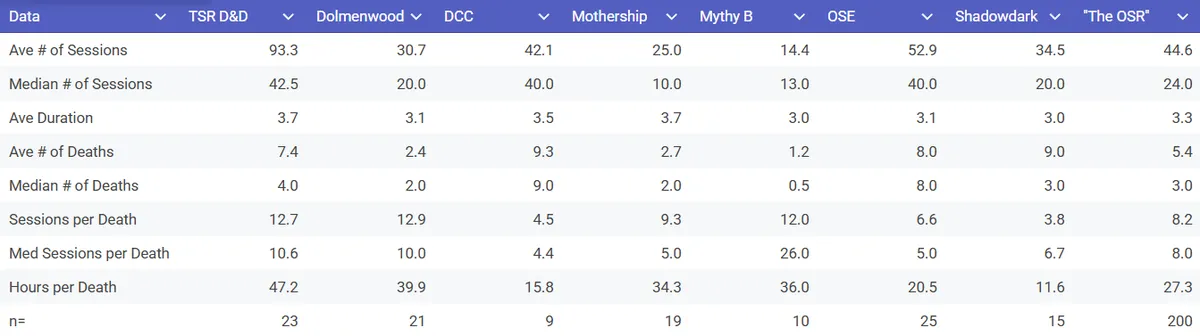
The average player's longest OSR campaign lasts 45 sessions and kills 5 PCs.
That average is heavily skewed by outliers and therefore unrepresentative.
The median longest OSR Campaign lasts 24 sessions and kills 3 PCs.
The most important takeaway is you can’t predict the lethality of an OSR campaign based on system or length. 21.5% of respondents’ campaigns had zero deaths, and those deathless campaigns had an average of 19 sessions played.2 Zero is the most common number of deaths a long OSR campaign can have.
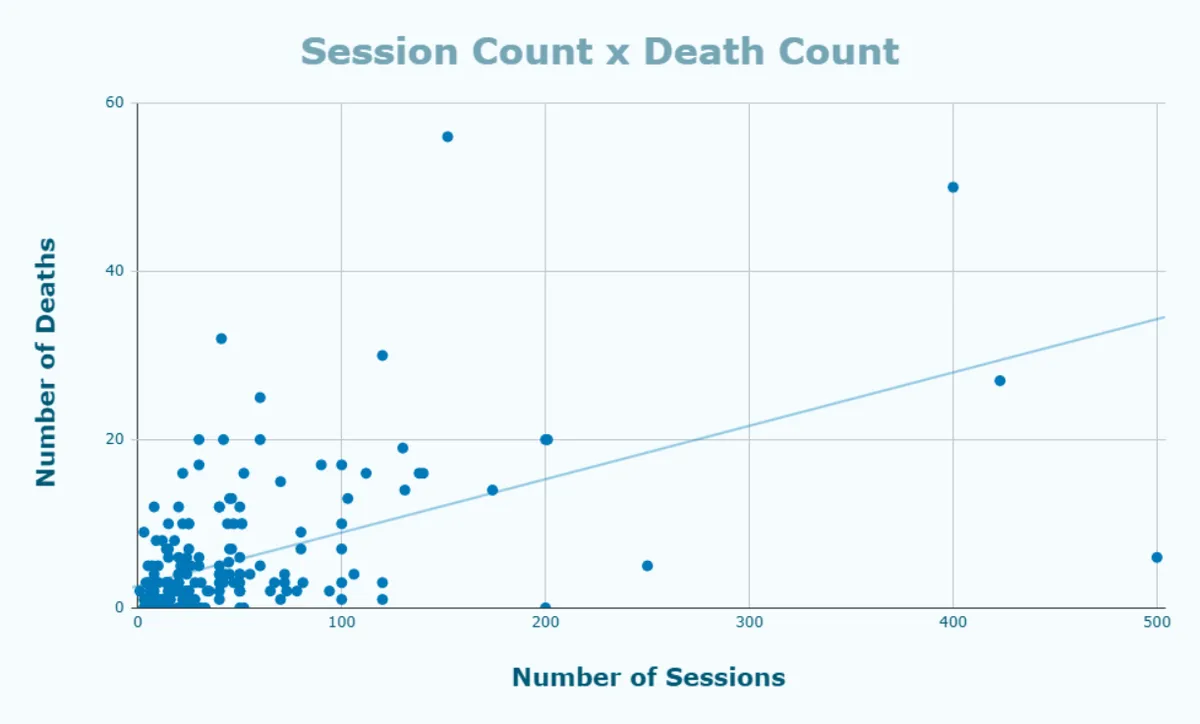
Each OSR system has a distinct culture in which deadly games are more or less prevalent. You can divide OSR lethality into two rough buckets:
| Meatgrinder | Picaresque |
|---|---|
| One death per 5 sessions | One death per 12 sessions |
| Shadowdark, OSE, DCC, Mothership* | TSR D&D, Mythic Bastionland, Dolmenwood |
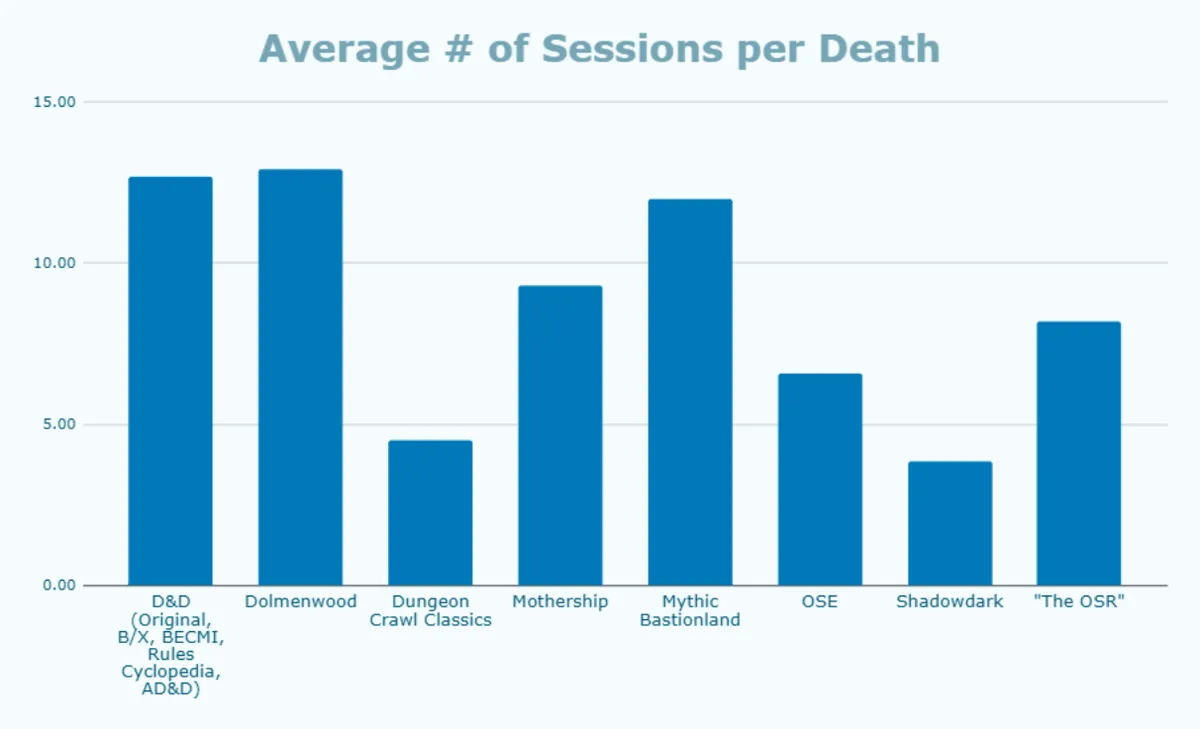
These buckets are unrelated to campaign length. The OSR accommodates long campaigns where lots of PCs die…
| System | Sessions | Deaths |
|---|---|---|
| Shadowdark | 152 | 56 |
| Classic Traveller | 120 | 20 |
| TSR-era D&D | 400 | 50 |
…and long campaigns where nobody dies.
| System | Sessions | Deaths |
|---|---|---|
| Shadowdark | 50 | 0 |
| Cairn | 31 | 0 |
| Cloud Empress | 52 | 0 |
There are two exceptions to these trends:
- Mothership campaigns are uniquely sorted into short meatgrinders and long picaresques. Longer MoSh campaigns have few deaths, and short campaigns kill. This makes its campaign data very skewed - the average number sessions per death is 9.3, but the median is 5.
- Mythic Bastionland campaigns are almost always picaresque. I found only a single table running meatgrinder MythyB, which cements it as the least lethal OSR game. This might be related to how powerful knight PCs are.
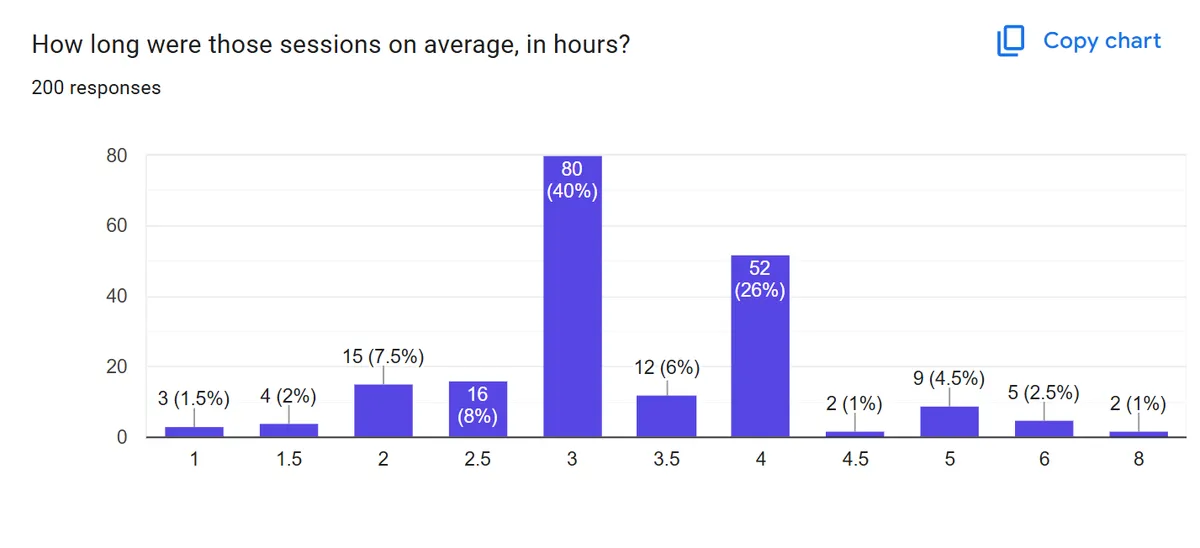
“Table culture matters most” was completely borne out. The only statistic OSR games universally had in common was session length - 72% of us are playing 3-4 hour games.
Limitations
First, remember that this data is not the average of OSR campaigns as a whole, it’s an average of each person’s longest OSR campaign. Asking folks to list every game they played would’ve cratered response rates. Most OSR campaigns are by-definition shorter than what I’m describing here.
Second, I collected no data on non-OSR games. I don’t have a 1:1 comparison to tell me how much more lethal or short OSR games are. This three year old survey on 5e module completion times leads me to believe that the average campaign length is slightly higher but much less varied - in the 40-60 session range. This EN World survey suggests lethality comparable to Mythic Bastionland, assuming 40-60 session campaigns. It seems like Daði correctly identified a subgenre of short meatgrinder games absent in his culture, but failed to account for the more conventionally paced blorby games under the OSR umbrella.
Third, I suspect Mothership is slightly overrepresented in the data. I posted the link on Bluesky, r/OSR, and a dozen different OSR discords, but my blog is slightly more well known in the Mothership community so I suspect those folks were more excited to fill out my survey.
Fourth, I’m measuring deadliness via the number of players who died, not how dangerous the threats were. Players have agency. A careful party can make smart choices to escape the jaws of death - that’s the whole point. I can’t know from a death count if the party was tryharding Stonehell or being goo drinkers3 in a picaresque setting.
Fifth, I only had enough data to run system-by-system comparisons on 7 games - TSR D&D, Dolmenwood, DCC, Mothership, Mythic Bastionland, OSE, and Shadowdark. They collectively accounted for 61% of the longest OSR campaigns played. If you count the TSR games and their retroclones as a single mass, they account for 31.5% of all campaigns surveyed.4
Why didn’t Daði know about Picaresque D&D?
Mostly a lack of familiarity with the scene, as he readily admits, but I have another theory.
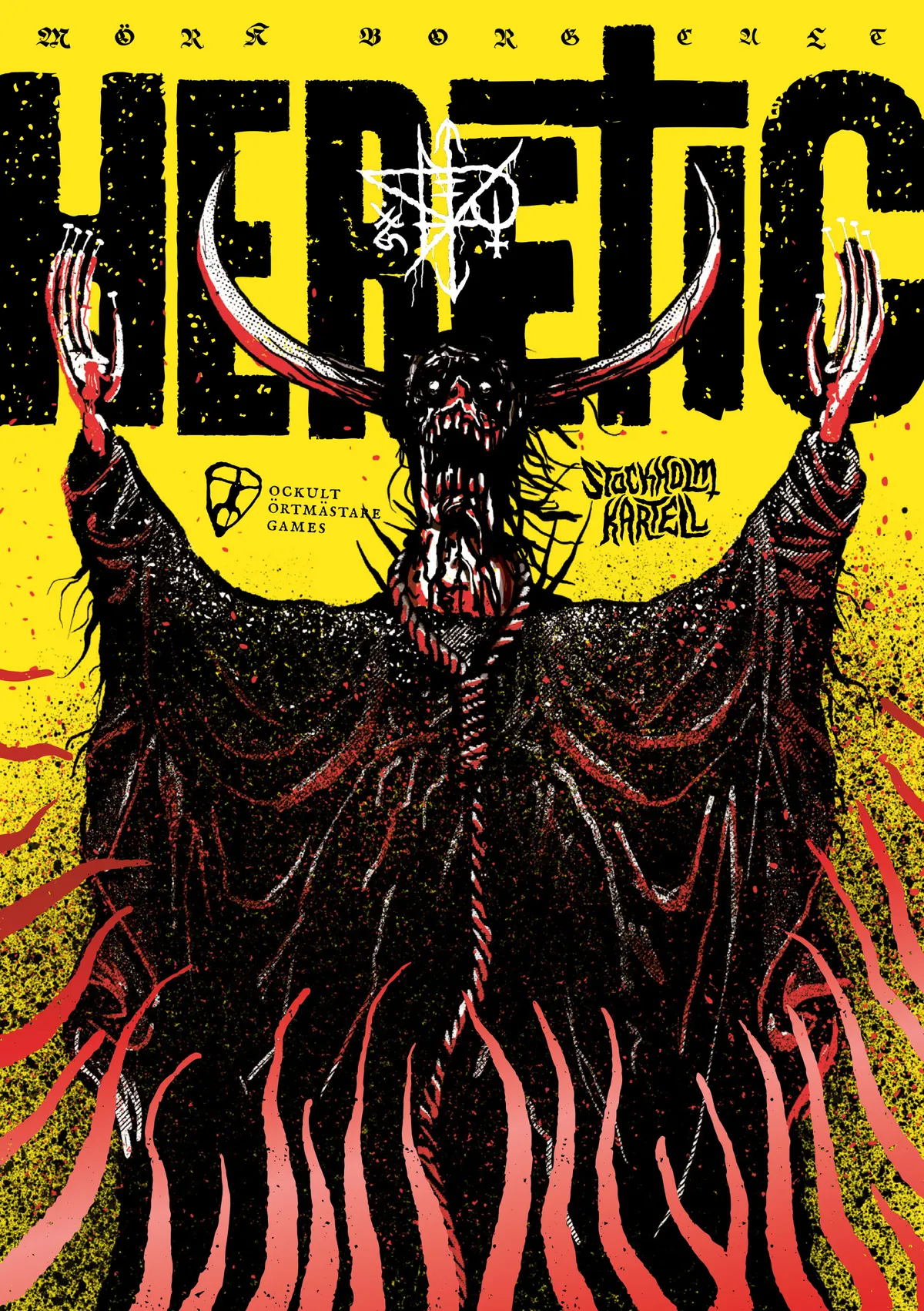
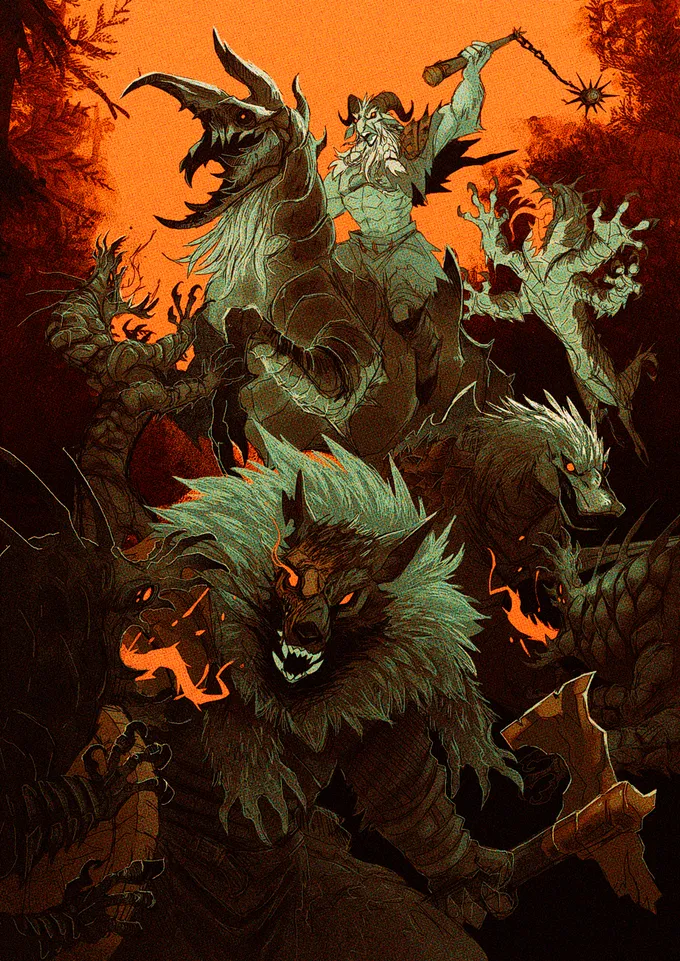
Meatgrinder D&D has a loud, popular, unified aesthetic. Picaresque D&D does not.
The closest we have are pictures of weirdos camping. Recognizably human characters with plenty of tools, a lot of backpacks, but no blood.
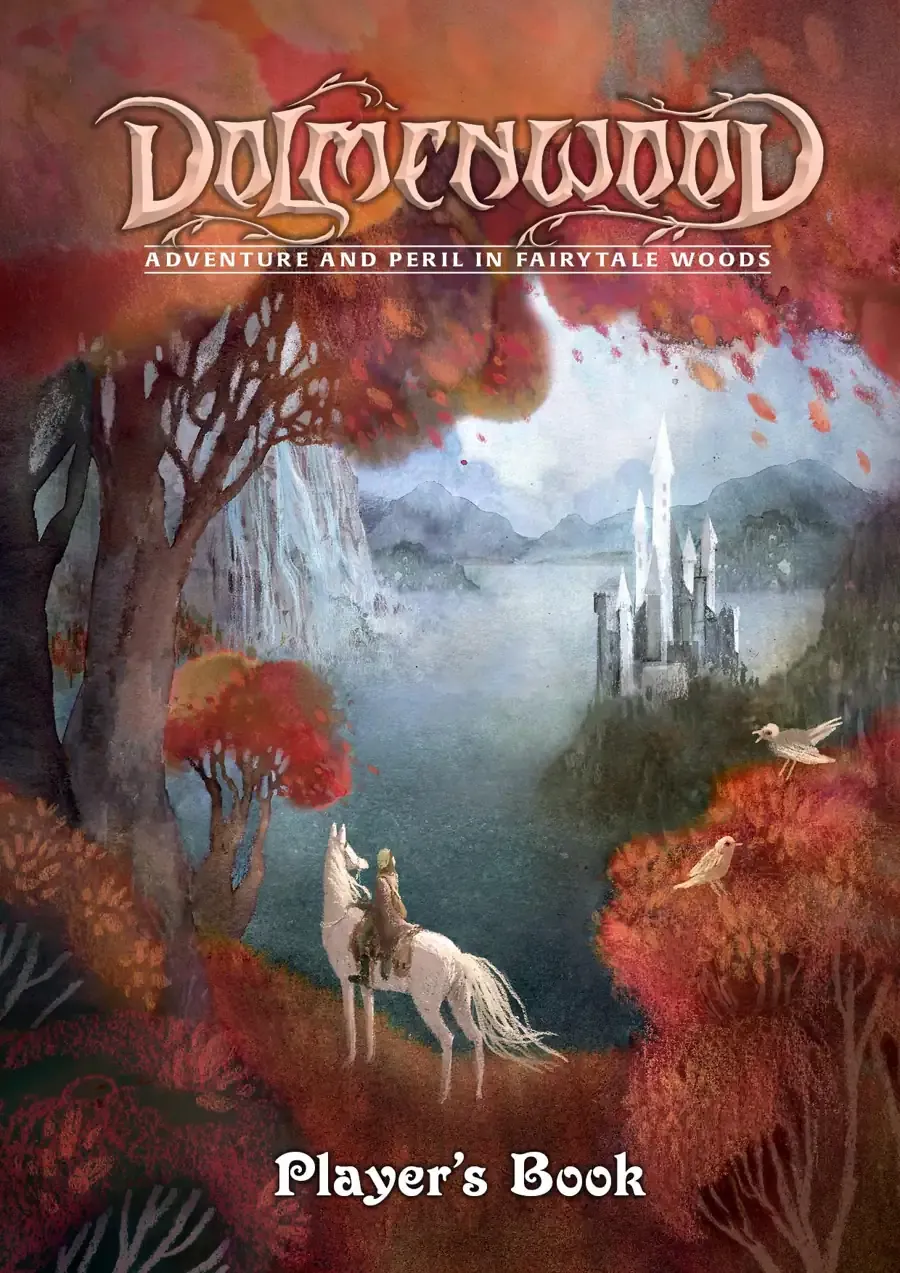
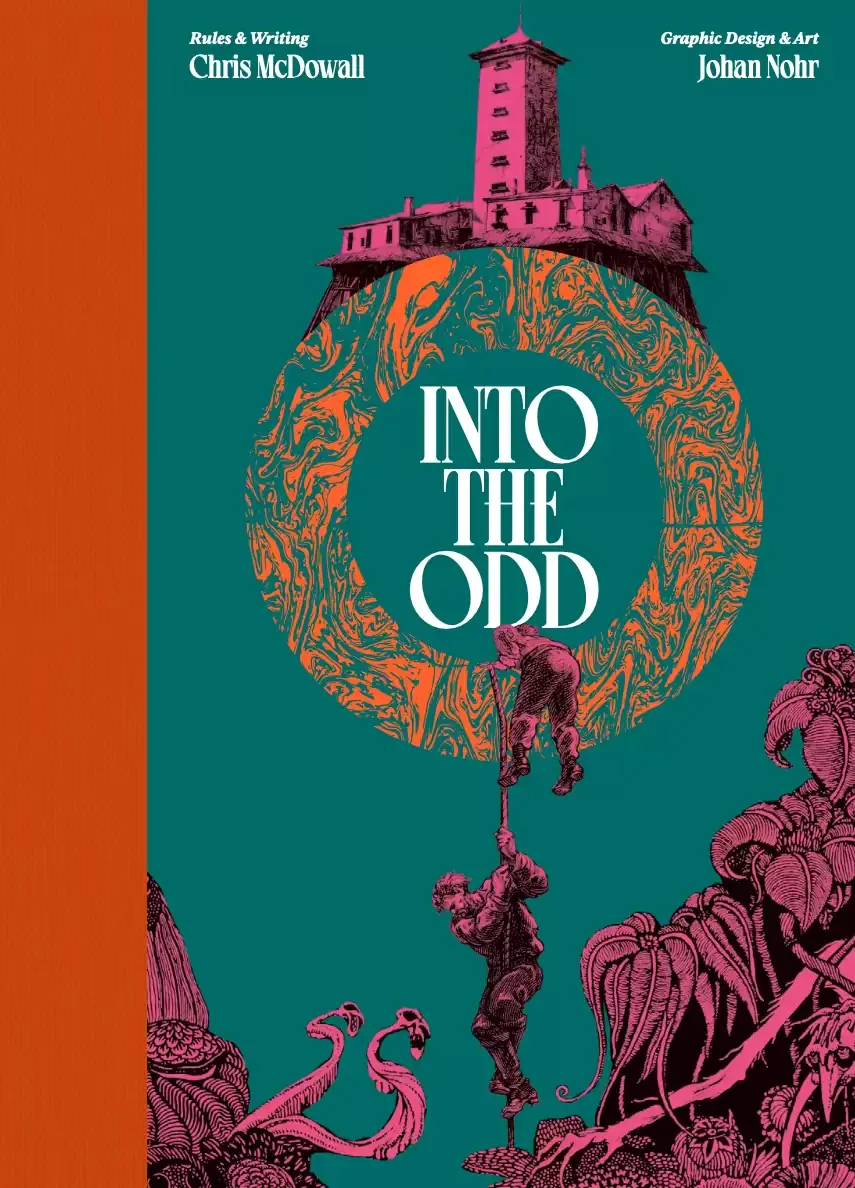

I’d really love for the picaresque side of the OSR to become more self-conscious and visible. That agency maximizing middle ground between doomed and demigod is my favorite threat level for a campaign to have.
————————————————————————
For the unfamiliar - “when you hit zero hp, you’re guaranteed to survive but the DM gets to substitute death with another horrible consequence.” A lot of folks in the hobby dislike these mechanics; some for good reasons, some for bad. If you’re the type who really wants to treat these games as a test of skill, more power to you. However, a lot of folks hold the contradictory desires that “the threat of death should be omnipresent” and also “unanticipated deaths should never occur”. To the latter camp I argue: is beating Elden Ring not an accomplishment? Preventing permanent failure is not the same thing as guaranteeing success.↩
The median number of sessions in a zero death OSR campaign is 12. Every major system had a deathless campaign or two, but they were most common in Cairn, Dolmenwood, and Mythic Bastionland.↩
aka “players who take outrageous risks for fun"; drive their character like a stolen car.
Copyright Gin Bradbury, 2024EDIT: Copyright VICIOUSLY CONTESTED by GLoG server representatives, will update as new casualty totals arrive.↩Twenty-three systems were only represented once. Reading through the rare picks in these surveys is always a treat; I came away with four new games on my reading list! Firetales, Grave, Sojourn, and Midnight of the Century.↩