Daggerheart - a Dishonest Review (full of Lies)
Daggerheart is the first PbtA game that isn’t edgy
For decades, indie tabletop design has been fueled by its disillusionment with Dungeons & Dragons. We resent Hasbro not just for its corporate excesses, but because it finds the brand of D&D more valuable than the game system that bears its name. The latter will always be compromised to preserve the former, which renders D&D’s mechanics an easy target for aspiring game designers to surpass. I have this kernel of resentment to thank, in part, for much of the coolest art in my life.
Daggerheart is free of this hate. Daggerheart absolutely loves modern neotrad 5e D&D. That love forces it into a strange relationship with the rest of the indie scene. Literally nobody I know in the blog-freak-backwoods is excited about Daggerheart. We’re excited for it to injure D&D of course, but Daggerheart itself feels like that friend of a friend you were introduced to at the function because you share interests on paper, but who you actually don’t vibe with in any way. He’s not, like, a bad guy or anything, he’s just not your speed y’know? Kinda vanilla. A little cringe. So you only half pay attention to what he’s talking about while trying to slip come-hither glances at Mork Borg so she can rescue you from the conversation.
I am here to tell all of you that your prejudice has led you astray. Daggerheart is excellent. Your D&D baggage is not his problem, and you should give him a chance.
Duality Dice take the stress out of Mixed Successes
The basic resolution procedure is 2d12 roll-over, with the familiar D&D DC tiers (10 is easy, 20 is hard, etc). Two d12s of different colors are required - a Hope die and a Fear die.
In addition to the results of the check, if the Hope die's roll is higher that player “rolled with Hope” and receives “a Hope” - a meta resource players expend on their coolest powers. If the Fear die is higher they “rolled with Fear” and the GM receives “a Fear”, expended to make scenes worse for the players (take extra enemy turns in combat, use the most powerful enemy abilities, etc.) On top of all of this, rolling with Hope or Fear is treated like a 7 - 9 result in PbtA. When players beat the DC of a check with Fear the GM is encouraged to make the situation worse for you without invalidating your success. Likewise, failures with hope are expected to give the PCs a lucky opportunity.
One of the chief criticisms voiced in other Daggerheart reviews is that the “mixed success” element of checks is often ignored in play. I view this as a feature, not a bug. Creating compelling mixed success results roll after roll is often cited as the most stressful part of modern storygaming. By layering a flexible narrative result on top of a crunchy mechanical base, Daggerheart gives players permission to ignore mixed outcomes when no compelling story beat comes to mind. It’s the outermost layer of its mechanical onion - present when useful, easily ignored when laborious.
The Hope & Fear economy deserves a lot of praise in its own right. Hope acts as a universal resource system. Any ability you’d normally track uses of - spell slots, once-per-short-rest - instead requires players to spend Hope. Because Hope is randomly generated, there’s genuine tension over whether characters can summon the inner strength to use their most powerful attacks. The input randomness creates real drama and novel resource management puzzles. Hope is to fatigue tracking what the Overloaded Encounter Die is to time tracking.1
In practice, Fear is a teaching tool for proper session pacing - a crude but effective psychological trick. Expending a heap of tokens to screw over the party feels earned in a way fiat doesn't. The system is encouraging you to be mean while also setting an upper limit to how mean you should be at any one time. If you want that dramatic “all is lost” moment for the party, Daggerheart forces you to hoard fear and, thus, give the party an easier time leading up to that fall. As someone who’s long learned these pacing lessons, I barely noticed the fear system was there. It never once felt restrictive or invasive.
Character Sheet as Fidget Toy
The player-side of Daggerheart is defined by resource management mini-games. Fiddling with Domain cards, HP, Stress, Hope and Armor is the beating heart of combat in a manner reminiscent of modern board game design. Despite all the meters, Daggerheart ensures that play proceeds smoothly by keeping its integers small2, its word count brief, and its decision points clear and impactful.
This is easily the most polished trad game I’ve ever read. Every element of mechanical friction or rules annoyance endemic to the “big game” genre has been filed off through rigorous editing and world-class reference sheets.3 I’ve run one-shots of this game with parties who never read a single page of rules and it felt effortless.
The majority of the game's crunch is quarantined to these player-facing minigames and is invisible to GMs running the session. Running enemies is more involved than the rules light systems I’m used to4, but lands at the midpoint between Cairn and 5e.
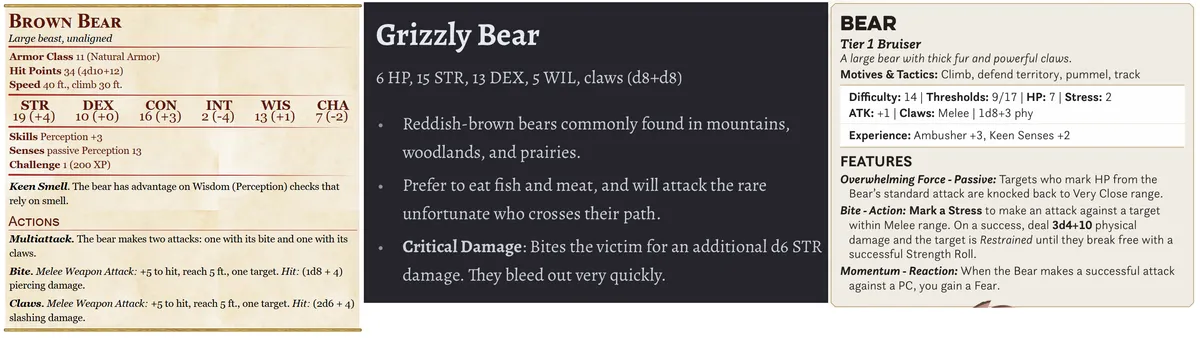
Because so much of the gameplay revolves around party-coordination and randomized resource management, there’s much less pressure on the GM to invest a lot of time into crafting compelling combat scenarios compared to other trad games. A bag of hit points that deals damage is genuinely all that’s needed to keep combat interesting at low levels. It took me about 20 minutes to create stat blocks for the White Horse of Lowvale one-shot I ran.
Aesthetic Crunch
The lengths this game bends over backwards to preserve traditional damage rolls is fascinating to me. The only “big number” left in Daggerheart is the 4d8+20 damage a high level fighter deals with their sword, and the only purpose of that number is to determine whether your attack deals 1, 2, or 3 hit points worth of damage. Half of the game’s armor system only exists to translate these dice piles back into Minor, Major, and Severe damage categories. Despite damage being just as vestigial as 5e’s Ability Scores, Spenser Starke deemed it too crucial to remove.
Though objectively silly, I’m hesitant to call this a mistake. These huge damage totals and the myriad ways to modify them are an intentional aesthetic choice. Dice piles resonate with the game’s target audience. Depressing as it is to say, it reminds me of modern gatcha design - math whose ultimate impact on play is real but intentionally obfuscated. The numbers are there to make you feel good, not to inform your choices.
Daggerheart is trying to have its cake and eat it too by giving the D&D optimizer crowd a little bundle of math to make as big as they can, while also mitigating the impact that effort has on gameplay. But this ignores that D&D’s optimization culture arose in response to a legitimate need - you absolutely can mess up a 3.5e character so badly that it inconveniences your friends. The gap between the most damage and the least damage a D&D character can do is vast. In Daggerheart, that gap is almost always “2”. I’m unsure whether the minuscule advantages Daggerheart’s character optimization affords will be enough to keep the power gamers entertained.
How funny is it that the best strategy to maximize market appeal is to look complicated while being simple?
The DM Tools are Useless to Me
How do you most effectively transmit fifty years of best practice advice from obscure blogs and oral traditions into the minds of novice game masters?
Daggerheart’s answer - just sorta list them out one after another for fifty pages.
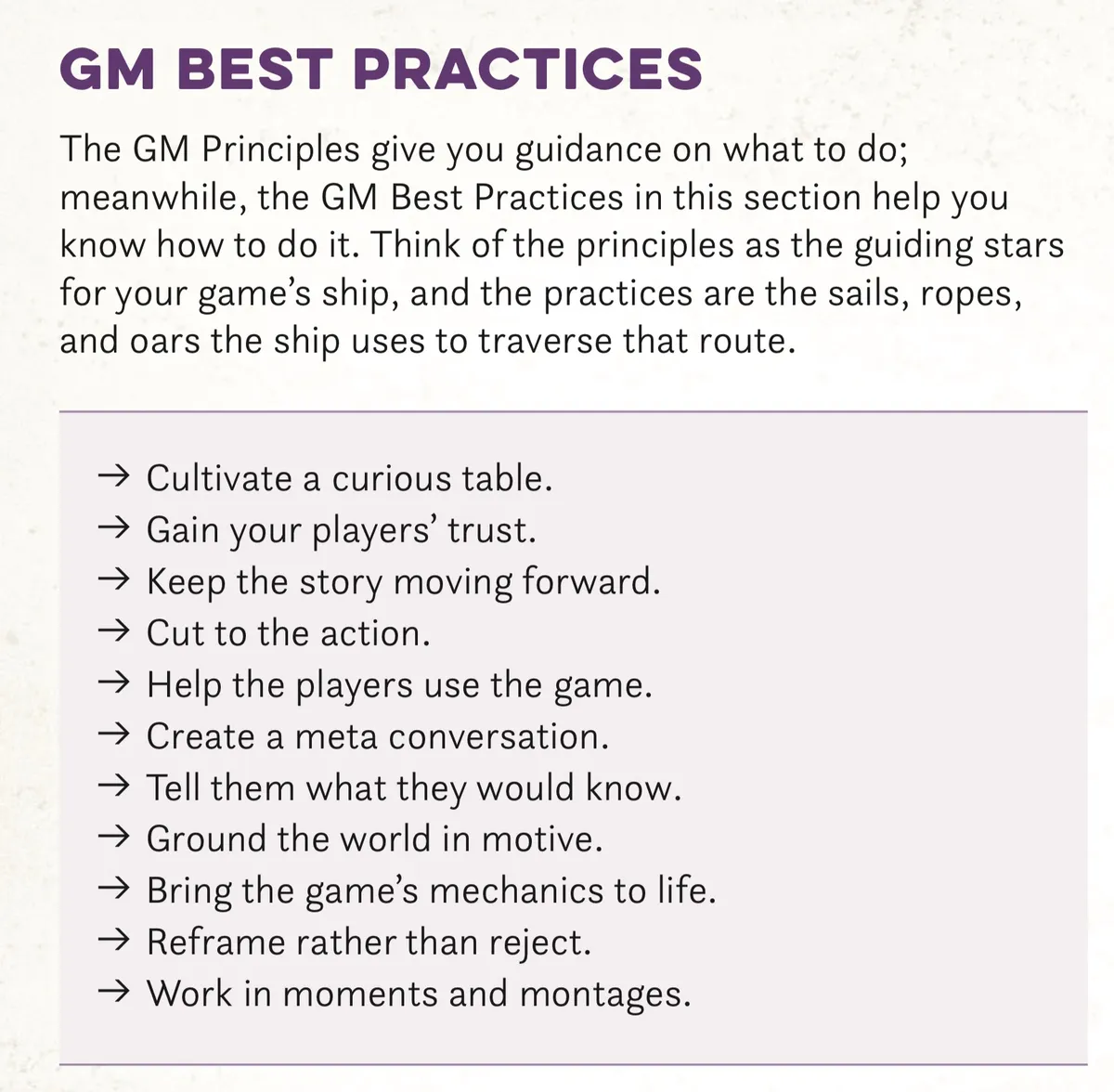
Is the advice good? Yes! But if you’re reading this blog, you’ve heard all of this before. The dev team was given an extremely hard job and did… passably. C-.
Unfortunately it only gets rockier from there. Daggerheart takes two big swings at reorganizing trad prep - environment stat blocks and campaign frames - and both were a miss for me. Bestiary aside, I could take or leave the entire back half of the book. Thankfully all of this material is explicitly optional. Its only inconvenience is the weight it adds to the tome.
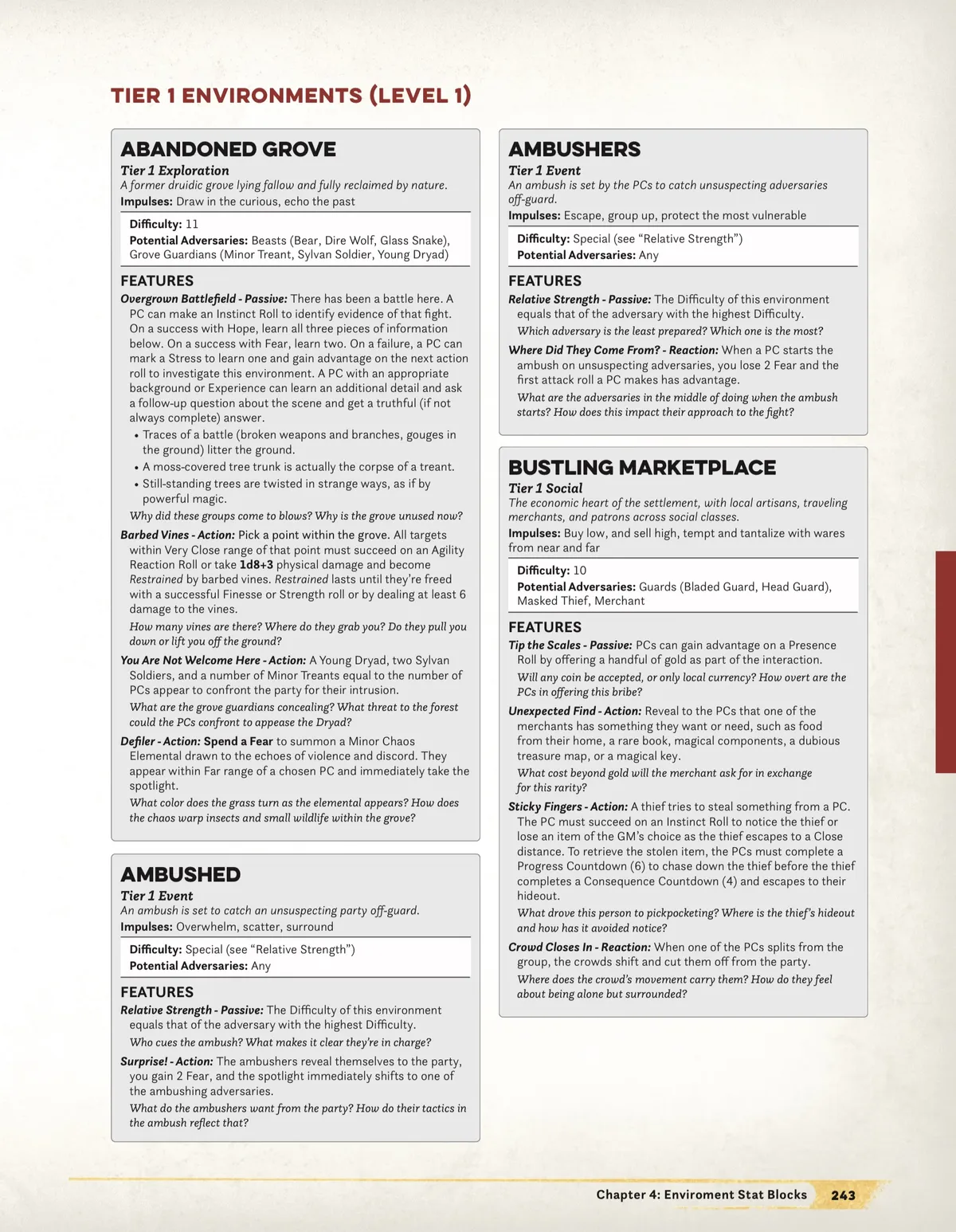
I don’t understand how any of these features are intended to be helpful when unmoored from a procedure that occasions their use. Using the “Bustling Marketplace” as an example, am I supposed to tell my PCs when they enter the market that “they can gain advantage on a Presence Roll by offering a handful of gold”? Why mechanize something that, diegetically, will already have the exact mechanical impact PCs expect? When am I supposed to use the Abandoned Grove’s “Barbed Vines” action, and why?
I think the intention is for these actions to be a quiver you can pull from when rolling mixed successes, but in that case I’d want positive outcomes listed out for 'Failures with Hope' as well. Forcing GMs to make their environments impact the players is good practice, but the text bloat added by all these bolded action names and “impulses” clouds my thinking more than it sharpens it. Just give me a rollable table full of good and bad outcomes.
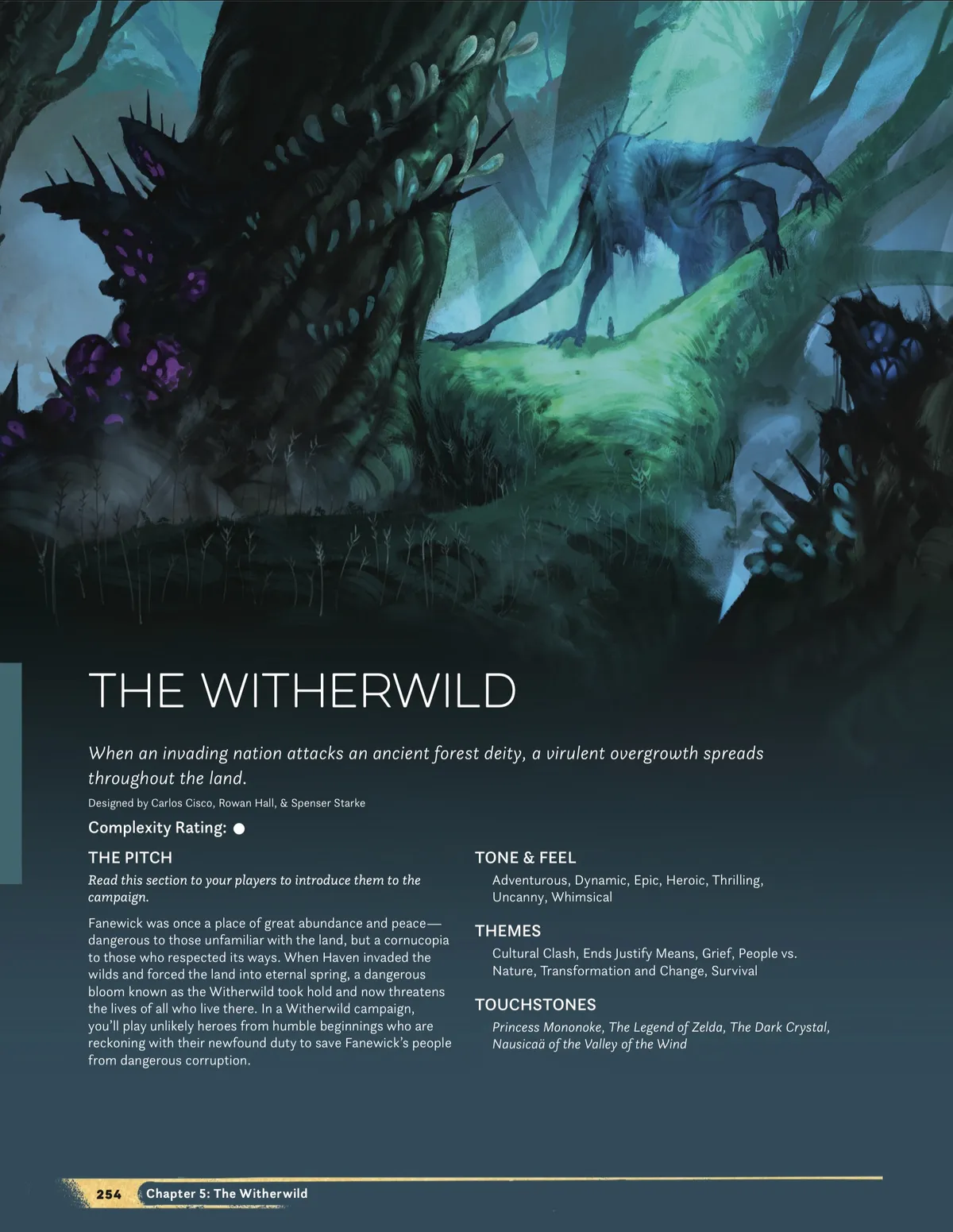
Campaign frames are just modules that edge you. They give you beautiful maps with nothing on them. Gorgeously sketched monsters with no stat blocks. Pages of principles and touchstones that it's my job to actually apply.
None of these campaign setups are dweeb adventures. The Witherwild frame in particular sounds completely awesome to me, but literally none of the level design has been done for you. It is up to the GM to turn these cool ideas into a capital-G Game, and the book treats that like a selling point.
Additional details do not preclude my ability to make a setting my own. It should not be every GM's responsibility to flesh out the particulars of their own game. It should be one cool smart person’s responsibility, who we then pay handsomely for their labors. Thousands of collective prep hours instantly saved.
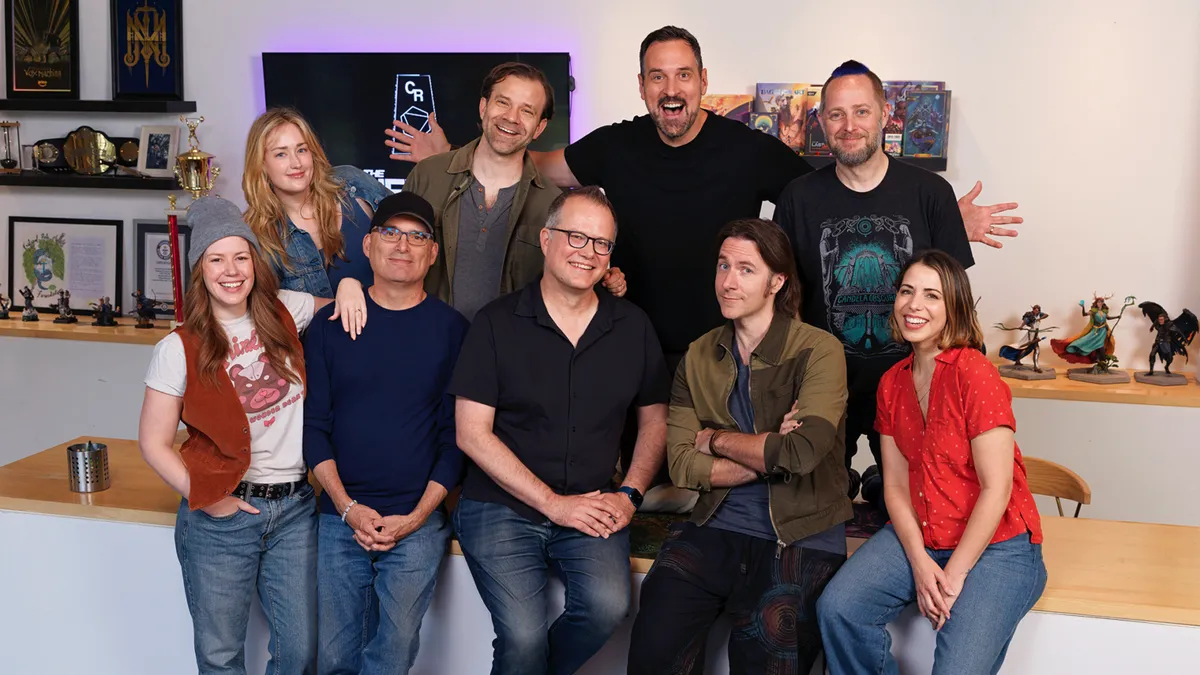
The First TTRPG for Cool Attractive People
Though efforts have been taken to mitigate the issue, Daggerheart strongly prioritizes at the table pen-and-paper play. The duality dice, domain cards, and range bands (defined by the lengths of pens and playing cards!) are all charmingly tactile but toothless in remote play.
Personally, I adore this. The vast majority of us desperately need more in-person socialization. But that’s Daggerheart asking its audience to change instead of meeting its audience where it’s at.5
Case in point - the culture’s reaction to its unstructured initiative system.6 Despite its sword & sorcery aesthetic Daggerheart is not a wargame. Who-moves-when is broadly unimportant so long as scenes have an interesting ebb and flow. But the D&D playerbase really tore into Spenser for this change - not just out of knee-jerk simulationism, but because they were deeply worried that, without initiative to preserve fairness, shy players would rarely get a turn.
To reiterate - their complaint is not that the game is worse sans initiative, it’s that most D&D players genuinely feel that they need Daddy Thick Book to demand their friends check in on them in order to feel comfortable at social gatherings.
That sucks, right?
It’s such an indictment of the culture to see hundreds of players cling to initiative like a life raft, so scared that without an equitable pre-ordained portion of screen time nobody at their table will care what they have to say.
An optional “Spotlight Tracker” rule papers over this complaint, but I suspect the breadth of this backlash was a genuine surprise to the dev team. As far as my sleuthing can tell, they all seem like happy well adjusted adults who love each other - the kind of people who’d always take personal responsibility to ensure the people around them feel safe and cared for. Unfortunately, a huge chunk of their game’s target demographic is immature teenagers.
A Passionate Defense of OC Fantasy Slop
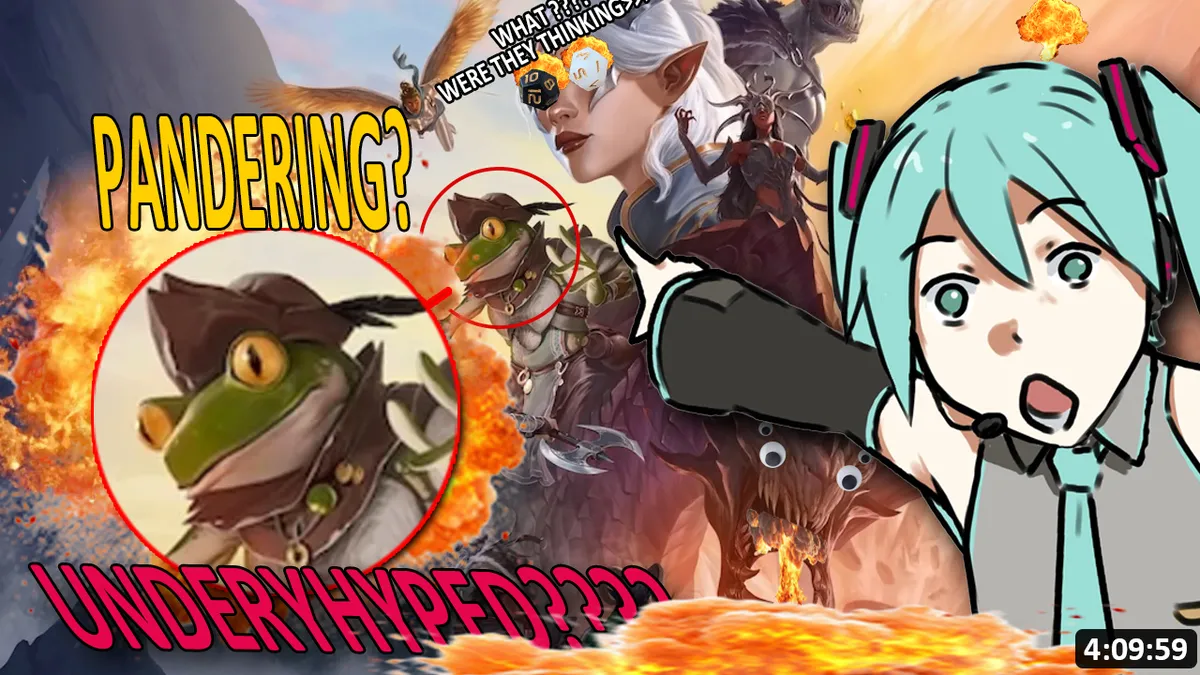
There’s a Frog man in a tricorn hat casting holy magic on the cover of this book.
I think half of my blog’s audience instantly nopes out of any system that allows that as a first level character. And that’s valid! At this stage of my life, I’m playing Human Fighters in every fantasy game till the day I die.
But wacky races are the right choice for this book. And the reason it’s the right choice is not because ‘the 5e crowd has poor taste’, or some other belittling excuse. I think, in a roundabout way, it’s our fault that trad games need to be so ‘silly forward’ in their marketing.
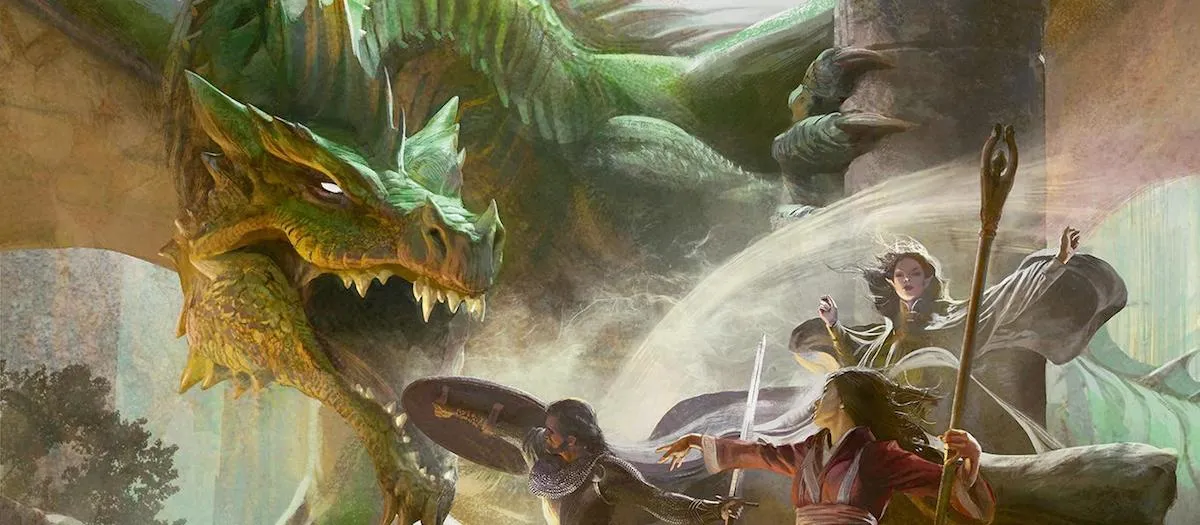
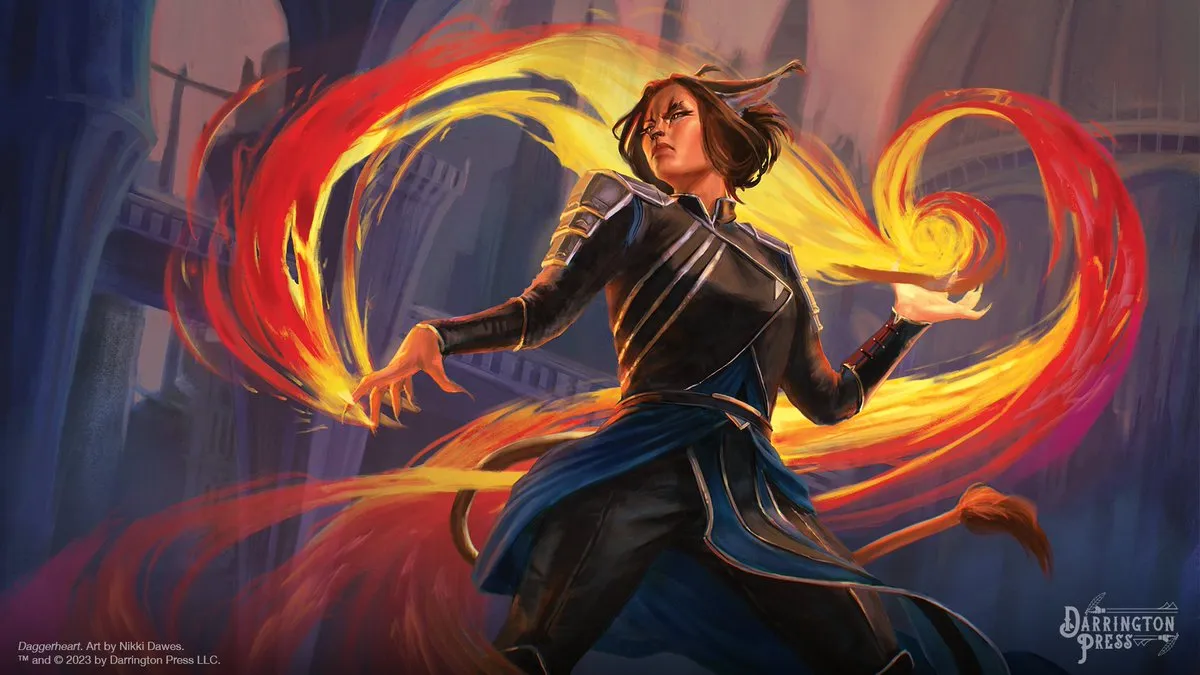
TTRPGs have utterly failed to communicate how lighthearted this hobby is to outsiders. When I tell my coworkers that I play D&D, most of them are imagining the image above. Something like a Lord of the Rings LARP mediated by complicated math. Therefore, most new converts to the hobby - intimidated by the serious game they imagine D&D to be - try to pull the game in a direction more comfortable to them. They play clowns and humanoid bears to protect themselves with a layer of detached irony.
But the real irony is that this is the most popular way to engage with the game! The most beloved D&D stories are all absurd bits! So the same cycle keeps playing out at table after table. New players enter the hobby expecting D&D to be the butt of their jokes, realize everyone else is also doing bits, then become so emotionally invested in the joy the bits brought them that the game acquires genuine narrative weight.
This is yet another reason why new players aren’t interested in playing Cairn, ItO, or any other “D&D but better” indie system. By removing the D&D, you’ve removed the setup to their joke. It’s fun to take the imagined straight man of D&D down a peg, but is it fun to take… Vaults of Vaarn down a peg? No! That’s punching down.
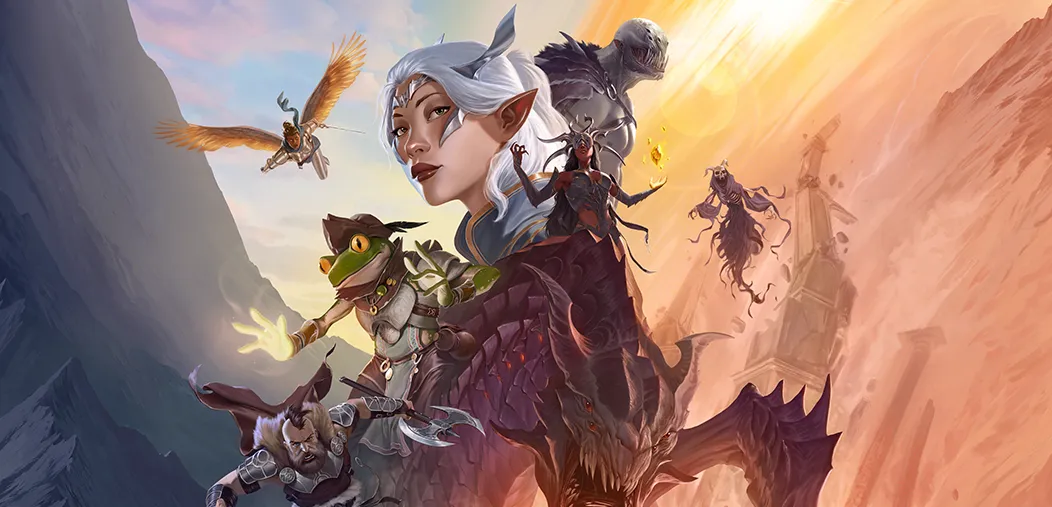
Darrington Press did not put this weird little frog guy on the cover to pander to the frog-lover demographic. They put him there because Spenser Starke is really weird about frogs it communicates a casual tone. It alleviates the biggest fear people who know nothing about TTRPGs have about TTRPGs.
To finally usurp D&D we need to make this hobby legible to outsiders. Now I know nothing about marketing, but I do not think it’s a coincidence that all of the breakout actual plays from the last decade star a gaggle of goofballs.
I get that "be funny and approachable" isn't the most actionable advice,7 so how do we as dorky self-serious bloggers actually help this very good fun much-better-than-D&D game bury its progenitor?
#1. Pivot to Short Form Video
This 3,000 word essay really isn't helping. This is me convincing you, the indie intellectual elite who actually read 3,000 word essays about fantasy games, to take Daggerheart seriously. But nothing any of us will ever write will get more views than this video of an adult man electrocuting himself.8
I nominate Sean McCoy to lead the charge on this one. Not just because he's successful and actually takes marketing seriously, but because he employs Luke Gearing, one of the low-key funniest people I have ever met. As an Over/Under lesbian, I am morally obligated to annoy Luke as much as possible. Few things would annoy him as much as forcing him to have a TikTok presence.9
#2 Viciously Gaslight your Friends
Tell them that D&D 2024 rebranded after the OGL drama. Show them the new Todd Kenreck Interviews. Lie through your teeth. How would they catch you? Nobody bought 5.5e anyway.
Post-OSR players must all fall in line in support of this game with the same grim conflicted fortitude that we vote for the Democratic Party. Will we trick every table into playing Daggerheart? No. But we MUST be annoyingly vocal about it. The grift doesn’t have to last forever, it just has to last until they learn the rules. Cool friends will respect your commitment to the bit.
Yes, I'm serious.
This review would've been so much easier if Daggerheart was bad. It would feel so vindicating for the hot successful California nerds to have hastily repackaged a bunch of indie design principles from the last 10 years for their own financial gain.
But they didn’t. Daggerheart is good - very good - even if every element of its design is optimized for the kind of vanilla fantasy most of us came to the indie space to escape. It deserves the crown it was made to steal.
$60 for a luxurious hardcover and hundreds of gorgeous ability cards.
Also you should vote me for Best Debut Blog because I think smart and write words real good.
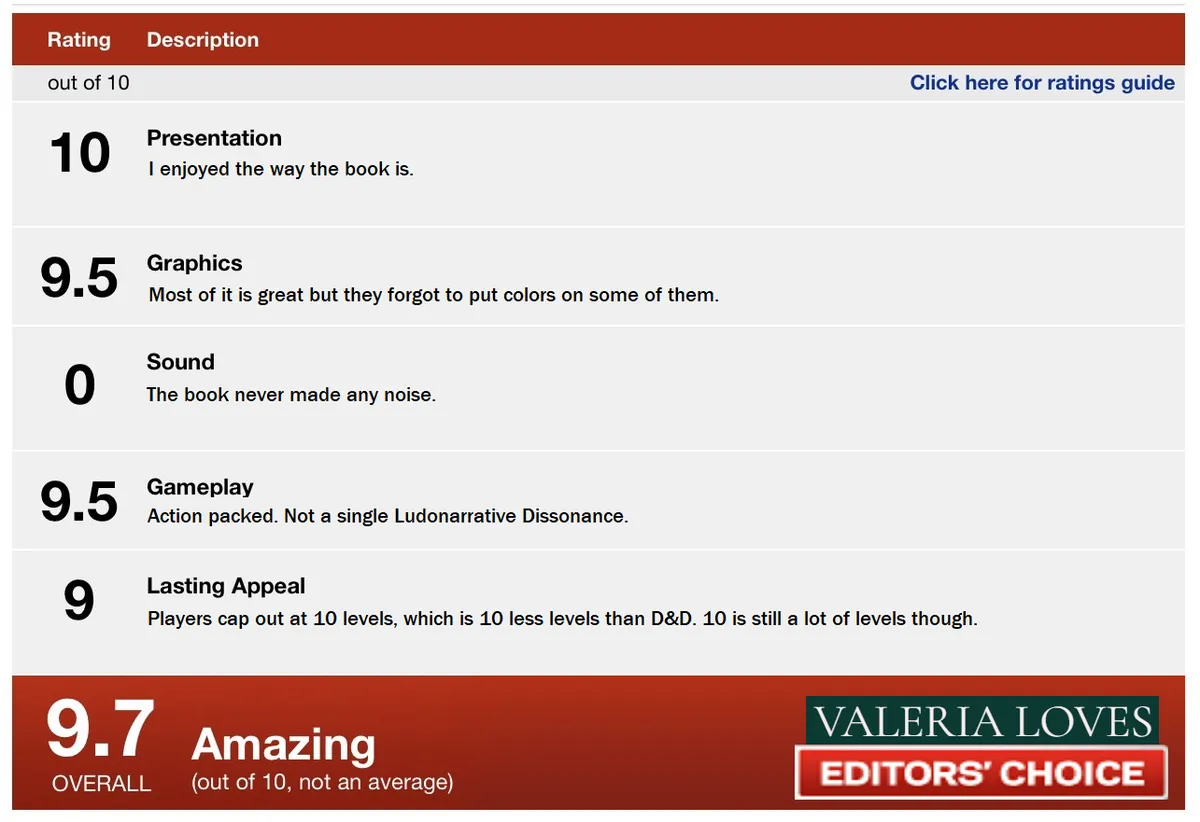
————————————————————————————
It feels surprisingly similar to Gambits in Mythic Bastionland.↩
“The Rule of 6 and 12” is a core tenent in the game’s design doc - aside from damage rolls, most numbers you interact with in the game hover around 6, and cap out at 12. It’s a subtle pattern in the game that helps you memorize its crunch.↩
Special shoutout to the Sidecar - all the benefits of Mothership’s character-sheet-as-rules-guide with none of the permanent visual footprint.↩
You track hp and stress for each enemy, for example.↩
Which is Discord. Its audience is on Discord.↩
Players go first and any player may take a turn at any time. If Mike has a cool idea, Mike’s permitted to take as many turns in a row as he wants. Enemies only take a turn when players fail action rolls or succeed on an action roll with Fear. The rule is literally “be considerate, but do whatever you want”.↩
After sucker punching them in my last review, I’d like to give the Lancer community credit where credit is due - they know how to be funny and approachable in spite of serious subject matter.↩
If you reply to this Bluesky post with proof that I'm wrong, I will bake you Snickerdoodles and mail them to your home.↩
To break kayfabe for a minute, if thinking about "indie RPG TikToks" turned your stomach, I'd invite you to be critical of that kneejerk opposition. Do you want indie RPGs to be popular, or do you wish the world was filled with the kind of people who would already love indie RPGs? Because those are not the same thing.↩